

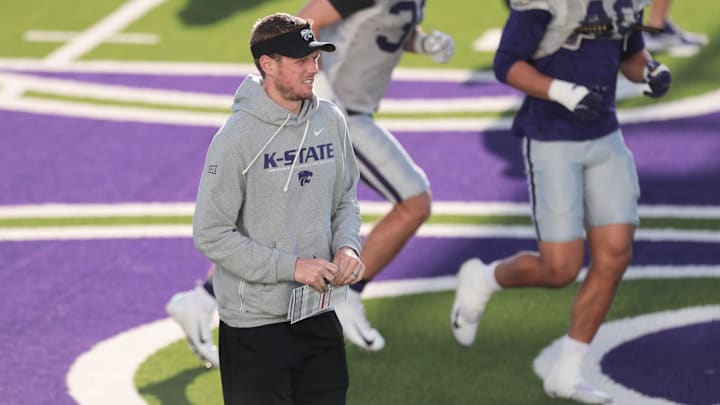
There's always a heartwarming element to former players taking coaching roles with their alma mater, and for first-year Wildcats head coach Collin Klein, it's anything but typical. Not only is he back on staff, he's leading the program.
Continuity across the program gives Kansas State a rare advantage
Klein entered the picture with a new motto: “It’s family business.” In many ways, that starts with him. During his playing career at K-State, Klein became one of the most recognizable quarterbacks in program history, leading the Wildcats to a Big 12 Championship in 2012.
The 2026 schedule is set.#EMAW pic.twitter.com/9uKbJ7Ruza
— K-State Football (@KStateFB) January 21, 2026
Ironically, this also is not his first return to Manhattan. Shortly after Kansas State’s Fiesta Bowl season, Klein came back as a graduate assistant before eventually departing elsewhere, including a stop at SEC powerhouse Texas A&M. Now, he returns once again, and this time as the face of the program.
And that familiarity matters. Fans appreciate the storyline and one of their own, but the bigger impact comes internally. Having a head coach who has lived the Kansas State experience gives the Wildcats a unique selling point in both recruiting and player development. For prospects, it's proof that success is possible, and doing so in Manhattan can lead to something bigger.
That kind of continuity is difficult to manufacture in modern college football, especially during a coaching transition. Kansas State already has it built in.
Wildcats avoided the reset most programs undergo
Every first-year head coach enters the picture with two immediate questions: who’s staying, and who’s leaving? In Klein’s case, the answer is more complicated. Yes, some players entered the transfer portal, but not at the level that typically signals a full roster teardown.
Instead of walking into a full rebuild, Klein inherited a roster that still believes it can compete in the Big 12. Avoiding a major roster exodus is often the first and most important hurdle in a coaching transition, and it appears the Wildcats cleared it.
And part of that comes back to familiarity. That matters more than ever in the transfer portal era, because it’s one thing to have talent and another to have cohesion. Teams can reload quickly, but building chemistry takes time. From that perspective, Kansas State isn’t starting from scratch.
With that level of retention, Kansas State avoided the usual early growing pains most programs face after a coaching change. Instead, it was able to spend that time building continuity and improving as a unit.
Player buy-in already moving ahead of schedule
The earliest indicator for any first-year head coach is whether the locker room actually buys in. So far, Kansas State looks like a program where that process has gone relatively smoothly, with only minor exceptions.
That early alignment is what ultimately makes or breaks a roster during a transition. And if things continue trending in this direction, the benefits of stability and trust will outweigh the adjustment period. Better yet, it won't even be close.
Bookmark Jug of Snyder and follow us on X with the username @JugofSnyder and Facebook @ksujugofsnyder.
 Add us as a preferred source on Google